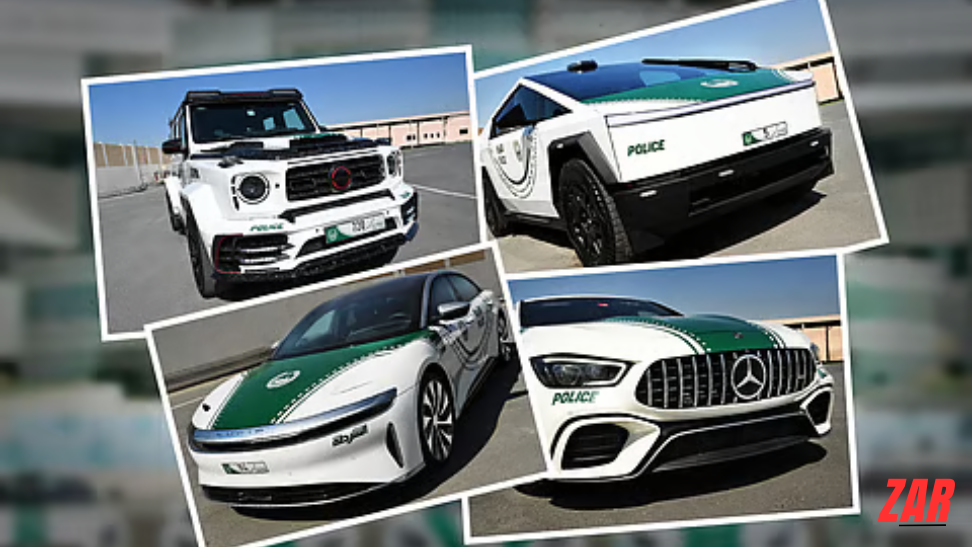
The Dubai Police Force, established in 1956, stands among the world’s most technologically advanced law enforcement agencies. In a city defined by rapid development, luxury lifestyles, and more than 18.7 million annual tourists, Dubai’s law enforcement approach balances innovation, efficiency, and prestige. From traffic management to VIP protection, the force’s operations reflect a blend of futuristic infrastructure and public engagement.
One of the most striking representations of this philosophy is its supercar fleet, a collection of high performance vehicles that combine engineering excellence with cultural symbolism. While these cars are not primarily used for high speed chases, they serve as public engagement tools, promoting tourism and enhancing the emirate’s global image.
The 2025 Dubai Police Supercar Fleet includes a blend of traditional combustion icons and cutting edge electric vehicles. Notable entries include the Bugatti Veyron, Lamborghini Aventador, Tesla Cybertruck, Rolls-Royce Cullinan Mansory, and Lotus Eletre R collectively valued between $100,000 and $1.5 million (₦142 million – ₦2.1 billion). Each vehicle embodies precision engineering and tailored adaptation to UAE’s unique climate, infrastructure, and social landscape.
Bugatti Veyron
The Bugatti Veyron headlines the Dubai Police collection, symbolizing power and prestige. Its aerodynamic design, low slung body, and signature horseshoe grille immediately command attention on Sheikh Zayed Road. The white and green livery of the Dubai Police transforms this hypercar into a rolling ambassador of authority and innovation.
Inside, the Veyron’s cabin maintains a balance between luxury and functionality. Premium leather and Alcantara upholstery, heated seats, and an analog tachometer surround officers in refined comfort. A central system and sound insulated cabin ensure operational focus during special duties.
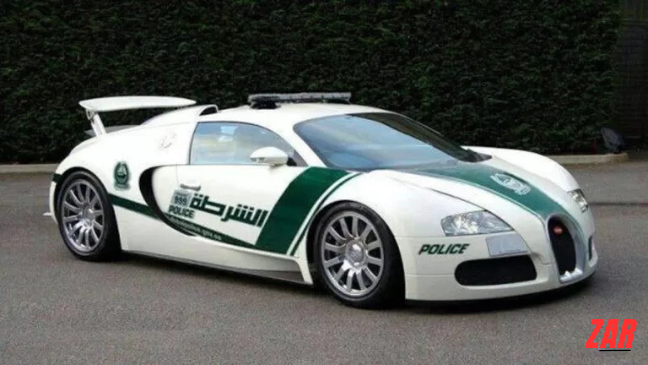
Beneath its sculpted frame lies an 8.0-liter quad-turbocharged W16 engine producing 1,001 horsepower and 1,250 Nm of torque. Power delivery through a 7-speed dual-clutch transmission enables a jaw-dropping 0–100 km/h sprint in 2.5 seconds, with a top speed of 407 km/h. Valued at $1.5 million (₦2.13 billion), the Veyron’s inclusion is less about routine policing and more about brand identity showcasing Dubai’s wealth, precision, and commitment to innovation.
Dubai’s meticulously paved roads and wide highways make the Veyron practical for city patrols and ceremonial duties. The region’s low humidity minimizes corrosion, while robust air conditioning systems handle 50°C heat. Fuel costs remain manageable, averaging AED 3 per liter, and authorized Bugatti service centers ensure prompt maintenance. Beyond engineering, its public display enhances Dubai’s global tourism appeal and reinforces the image of a city where luxury meets law enforcement.
Lamborghini Aventador
The Lamborghini Aventador adds an element of Italian flamboyance to Dubai’s fleet. Its wedge shaped design, scissor doors, and Y shaped LED headlights convey aggression and precision, while the police livery balances authority with spectacle.
The interior mirrors a fighter jet’s cockpit carbon-fiber panels, leather seats, and a 7 inch infotainment screen. The ergonomically arranged controls allow quick access to critical systems, while ambient lighting and dual-zone climate control ensure officer comfort.
Under the hood, the Aventador’s 6.5-liter naturally aspirated V12 engine produces 700 horsepower and 690 Nm of torque. The car accelerates from 0–100 km/h in 2.9 seconds, reaching a top speed of 350 km/h. The all wheel drive system provides stability on Dubai’s long expressways, and adaptive dampers soften its rigid suspension for smoother rides. Priced at around $400,000 (₦568.8 million), the Aventador combines mechanical artistry with visual dominance.
Dubai’s smooth road network allows the Aventador to thrive, though its firm suspension limits use on rougher urban roads. Cooling systems perform exceptionally in desert heat, and high fuel availability offsets its 15 L/100 km consumption. Servicing at Lamborghini’s Dubai facility ensures quick turnaround, while public interactions with the car strengthen the force’s approachable image.
Tesla Cybertruck
The Tesla Cybertruck represents Dubai Police’s commitment to the future, a symbol of sustainability and cutting edge design. Its stainless-steel exoskeleton, minimalist front fascia, and triangular LED bar headlights give it an unmistakable sci-fi aesthetic.
The cabin features five vegan leather seats, a massive 18.5-inch touchscreen, and voice controlled functions for nearly all operations. Advanced Autopilot systems support semi-autonomous driving, while air conditioning and ambient lighting maintain cabin comfort during long patrols.
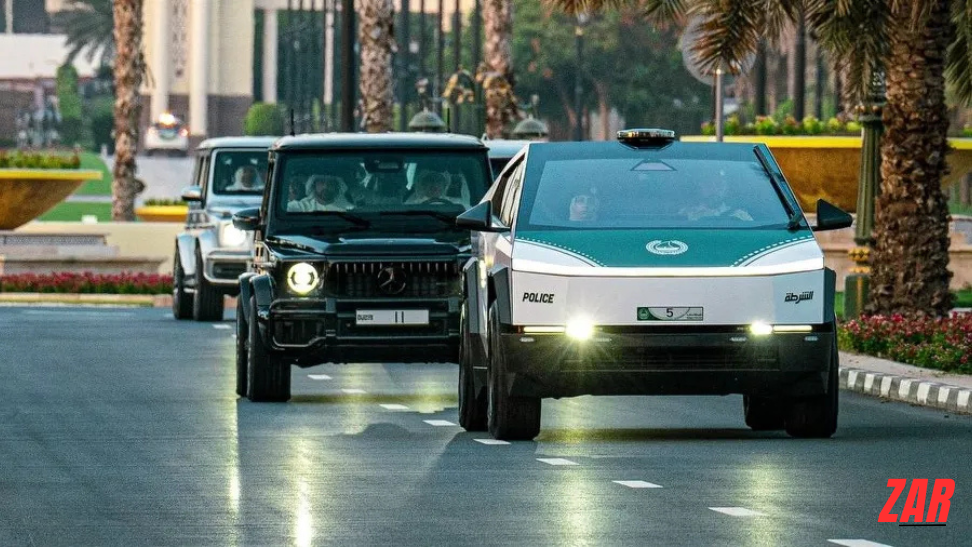
Dubai’s growing EV infrastructure, with more than 1,000 public chargers, makes the Cybertruck operationally practical. Electricity costs at AED 0.30 per kWh keep running expenses below AED 2,000 monthly. Heat management via liquid cooled batteries prevents performance degradation in 45°C conditions. Tesla’s Dubai network handles maintenance efficiently, making this vehicle a logical and futuristic step for smart policing.
Rolls-Royce Cullinan Mansory
Where performance meets opulence, the Rolls Royce Cullinan Mansory delivers unrivaled luxury. Its commanding SUV proportions, carbon fiber body accents, and illuminated Pantheon grille exude quiet power. Painted in white and green, it projects both authority and elegance.
The cabin is a sanctuary of craftsmanship hand stitched leather, wood veneers, and massaging rear seats enhance comfort. A 12.3 inch infotainment system, rear screens, and ambient lighting ensure the experience rivals a private jet.
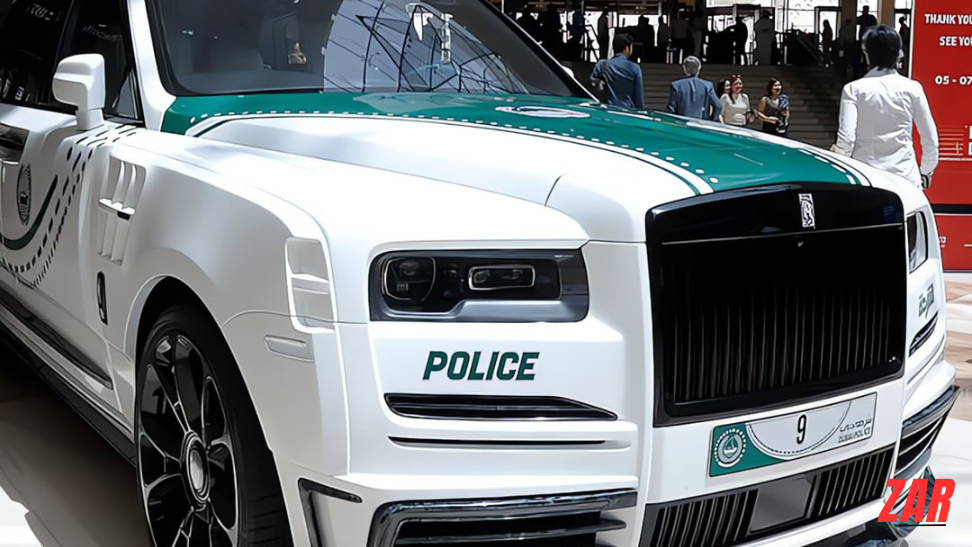
Dubai’s smooth highways and upscale districts perfectly accommodate the Cullinan’s dimensions. Its advanced air suspension adapts to heat expanded tarmac, while premium climate control handles Gulf humidity. Though fuel consumption averages 14 L/100 km, availability and subsidies mitigate costs. Rolls Royce’s Jebel Ali service center manages upkeep efficiently, with annual maintenance costs around AED 150,000, often covered by sponsorships.
Lotus Eletre R
The Lotus Eletre R brings electric elegance and high tech performance to the Dubai Police lineup. Its design merges sportiness with SUV practicality, featuring active aerodynamics, matrix LED lighting, and flush door handles that enhance aerodynamic efficiency.
Inside, the Eletre R emphasizes sustainability and innovation. Alcantara and recycled fabrics, a 15.1-inch OLED display, and biometric climate control redefine futuristic luxury. A 21 speaker KEF audio system and LiDAR-based semi-autonomous functions reinforce its technological dominance. Twin electric motors deliver 905 horsepower and 985 Nm of torque, enabling 0–100 km/h in 2.95 seconds with a top speed of 265 km/h. Its 600 km range and two speed transmission ensure long-distance efficiency and smooth acceleration. Valued at $230,000 (₦326.8 million), it represents a balance of sustainability, speed, and prestige ideal for a city leading global innovation.
The UAE’s fast-expanding charging network supports the Eletre’s energy needs, and built-in thermal management protects against battery heat stress. Adaptive ride height enables smooth transitions between highways and mild desert conditions. With annual costs around AED 15,000, the Eletre provides an eco-friendly yet high-performance option for Dubai’s modern police force.
Competitive Comparison
In the hypercar segment, the Bugatti Veyron outpaces rivals like the Koenigsegg Agera RS ($2.8M) and Rimac Nevera ($2.4M) in top speed, though the Agera offers similar acceleration for less. The Lamborghini Aventador ($400k) competes with the Ferrari 488 GTB ($280k) and McLaren 720S ($300k), with Ferrari edging in handling precision while Lamborghini dominates in emotional appeal.
For electric contenders, the Tesla Cybertruck ($100k) rivals the Rivian R1T ($73k) and Ford F-150 Lightning ($50k). Tesla wins on power and durability, while Rivian offers better off-road performance. The Lotus Eletre R competes with the BMW iX M60 and Porsche Taycan Cross Turismo, surpassing both in horsepower and futuristic design.
Ownership costs remain manageable under government sponsorships. The Veyron’s annual maintenance exceeds $100,000, the Aventador costs AED 100,000, and EVs like the Cybertruck and Eletre maintain under $5,000 yearly expenses emphasizing long-term sustainability in a luxury driven fleet.
Conclusion
The Dubai Police Supercar Fleet 2025 is more than a collection of exotic vehicles, it’s a cultural statement. Each model represents a strategic intersection of performance, prestige, and public engagement, reinforcing Dubai’s position as a global symbol of modernity and ambition.
From the Bugatti Veyron’s unmatched power to the Lotus Eletre’s electric innovation, this lineup illustrates how law enforcement can align technology, sustainability, and brand identity. Beyond patrol functions, these vehicles inspire civic pride, attract tourism, and symbolize how design and governance can coexist harmoniously.
As Dubai transitions further toward electrification, one question lingers:
Will future fleets favor sustainability over spectacle, or will the world’s most luxurious police force continue redefining enforcement through engineering excellence?