

If you drive in Nigeria, you will come across road signs almost every time you get behind the wheel. From the busy streets of Lagos and Abuja to major highways around Port Harcourt, Ibadan and other cities, these signs tell you when to stop, slow down, give way, avoid a particular road or watch out for danger ahead. Understanding the 10 road signs in Nigeria and their meanings can help you drive more confidently and, more importantly, avoid preventable crashes and traffic violations.
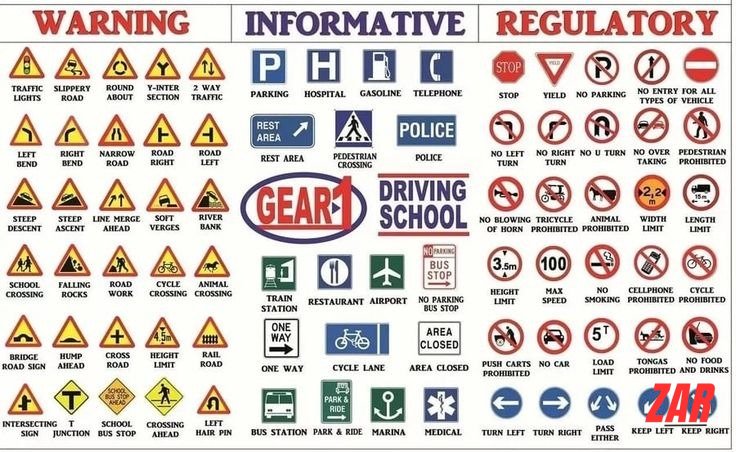
The Federal Road Safety Corps (FRSC) explains that road signs are used to direct, warn and inform motorists and pedestrians. The shape and colour of a sign can also give you an important clue about what it wants you to do. FRSC Road Signs and Markings Compendium If you want a broader explanation of Nigerian road signs, you can also read our complete guide to road signs in Nigeria before going deeper into this list.
1. Stop Sign
The Stop sign is probably the easiest road sign to recognise. It is an octagonal sign, usually red, with the word “STOP” clearly displayed. Unlike most other road signs, its unusual eight-sided shape allows drivers to recognise it even when the sign is partially obscured or seen from behind.
The meaning is straightforward: come to a complete stop. Do not simply slow down, glance left and right, and continue rolling. Your vehicle should actually stop before you proceed. After stopping, check for vehicles, motorcycles, pedestrians and other road users before moving when it is safe to do so.
The FRSC identifies Stop as the major exception to the normal circular regulatory-sign shape, making it especially important for drivers to recognise.
2. Give Way Sign
The Give Way sign is an inverted triangle with a red border. Its message is simple: allow other road users who have priority to proceed before you enter or cross their path.
Unlike a Stop sign, Give Way does not necessarily require you to come to a complete stop when the road is completely clear. However, you must approach slowly enough to stop if another vehicle or road user has priority.
You will commonly encounter Give Way signs at junctions, roundabouts and places where one road joins another. The important thing is not to assume that because you reached the junction first, you automatically have priority. The sign tells you to yield.
If you are still learning the difference between this sign and other regulatory signs, our detailed guide on road signs and their meanings in Nigeria explains the wider system.
3. No Entry Sign
The No Entry sign is a red circle containing a horizontal white bar. When you see it, do not drive into that road, lane or entrance.
This sign is particularly important around one-way roads, restricted entrances and areas where vehicles are not permitted to enter from your direction. In a busy city like Lagos, ignoring a No Entry sign can quickly turn a normal journey into an argument with traffic officials or, worse, put you directly in the path of oncoming traffic.
Do not confuse No Entry with a sign telling you that parking is prohibited. No Entry concerns access. If the sign is facing you, the road or lane is not for you to enter from that direction.
4. Speed Limit Sign
The speed-limit sign is normally a circular regulatory sign containing a number. The number tells you the maximum permitted speed in kilometres per hour for that section of road.
For example, if you see 50 inside the sign, you should not drive above 50 km/h. If a different limit is posted later, the new sign changes the applicable limit.
It is important not to assume that every Nigerian road has one universal speed limit simply because there is no sign nearby. FRSC publishes speed categories including 100 km/h for private vehicles, 90 km/h for commercial vehicles, 80 km/h for 20-tonne trucks and 60 km/h for 40-tonne trucks. Specific roads and situations can have lower posted limits. FRSC Speed Limiting Device Portal
The safest approach is to watch for posted signs and obey the applicable limit rather than matching the speed of the vehicle ahead of you. FRSC identifies speeding as a major contributor to road crashes.
5. No Overtaking Sign
The No Overtaking sign shows two vehicles inside a regulatory circle, indicating that overtaking is prohibited on that section of road.
You may encounter this sign before bends, narrow sections, bridges, junctions or other locations where overtaking could expose you to vehicles travelling in the opposite direction.
This is one of those signs that drivers should take seriously even when the road looks clear. A vehicle can appear far away and still reach you surprisingly quickly, especially on a highway. When No Overtaking is displayed, stay behind the vehicle in front and wait until you reach a section where overtaking is permitted and safe.
FRSC also lists wrongful overtaking as a traffic offence, showing that overtaking rules are not simply suggestions for drivers. FRSC Offences and Penalties
6. No Parking Sign
The No Parking sign tells you that you must not leave your vehicle parked in the restricted area. Depending on the specific sign and road markings, restrictions can apply to parking for a particular period or location.
This is especially relevant in busy commercial areas where a driver may think, “I’ll only park for two minutes.” Those two minutes can still obstruct traffic, pedestrians or emergency access.
It is also important to understand the difference between No Parking and No Stopping. No Stopping is generally more restrictive because it prohibits stopping except where an applicable exception or direction allows it. FRSC’s road-sign guidance identifies No Waiting and No Stopping among the regulatory signs.
For drivers operating in Lagos, traffic restrictions and enforcement are also covered by the state’s traffic management authorities.
So when you see a parking restriction, do not assume that putting on your hazard lights makes the restriction disappear. It does not.
7. Pedestrian Crossing Sign
The pedestrian crossing sign warns drivers that pedestrians may be crossing the road at a designated crossing point. You may also see the actual zebra markings painted across the road.
The correct response is to reduce your speed, watch carefully and stop when necessary to allow pedestrians to cross safely.
This becomes even more important around schools, markets, bus stops and busy residential areas. Children may not always judge the speed or distance of approaching vehicles correctly, so drivers need to anticipate their movements instead of waiting until the last second to react.
Pedestrian safety is part of the wider responsibility of road users, and FRSC’s mandate covers the safety of both motorists and pedestrians.
8. School Sign
The School sign warns drivers that children or school-related pedestrian activity may be nearby. It is commonly placed around schools, school crossings and roads used heavily by children.
When you see it, slow down and prepare for children who may suddenly cross the road, walk close to the carriageway or enter the road from between parked vehicles.
Do not treat a school-zone sign as decoration. The dangerous period is often around school opening and closing times when there can be a mixture of pupils, parents, buses, motorcycles and other vehicles.
A sensible driver reduces speed early rather than waiting until a child is already on the road.
9. Roundabout Sign
The Roundabout warning sign tells you that a circular junction is ahead. Depending on the location, you may also see directional signs or road markings showing which lane to use for your intended exit.
The key rule is to approach at a controlled speed, observe the signs and markings, and give way according to the applicable priority rules before entering. In Nigeria, vehicles circulate around a roundabout anticlockwise, so do not approach it as though traffic should move clockwise.
Roundabouts can become confusing when several vehicles arrive at once, particularly on busy urban roads. Avoid forcing your way into a gap simply because another driver appears to be giving you space. Make sure you understand the lane arrangement and have enough room to enter safely.
10. Men at Work Sign
The Men at Work sign is a warning sign showing road workers or road-construction activity ahead. It tells you that the normal road conditions may change.
When you see this sign, expect things such as cones, temporary barriers, lane diversions, construction vehicles, workers or reduced speed limits. The road may also become narrower than normal.
Do not maintain the same speed simply because you were travelling faster before reaching the sign. Construction areas require extra attention because workers and temporary traffic arrangements can change the normal flow of vehicles.
FRSC’s official offence list specifically includes construction-area speed-limit violations, so temporary roadwork restrictions should be taken seriously.
How to Remember the 10 Road Signs
One of the easiest ways to remember these 10 road signs in Nigeria and their meanings is to pay attention to their shapes before trying to memorise every individual symbol.
A Stop sign stands out because it is an octagon. Most warning signs are triangular, while many regulatory signs are circular. FRSC’s official road-sign guidance explains that signs are identified by their shapes and colours, with warning signs generally triangular, regulatory signs generally circular and Stop using the distinctive octagonal shape.
That means you can often understand the general purpose of a sign before you have even processed the symbol inside it. A triangle should make you think, “Something needs my attention ahead.” A regulatory circle should make you think, “There is a rule I need to obey.”
Where You Are Most Likely to See These Signs
The signs on this list appear across different types of Nigerian roads. Stop, Give Way, No Entry and No Parking signs are particularly relevant around busy urban junctions and restricted areas. Speed-limit and No Overtaking signs become especially important on highways, bridges and other high-speed sections.
Pedestrian and School signs are common around schools, markets, residential areas and busy pedestrian routes. Men at Work signs become important whenever road construction or maintenance changes the normal arrangement of a road.
The exact combination will depend on the road, local traffic conditions and the authority responsible for the route. Nigeria’s Federal Ministry of Works and Housing also publishes highway standards and manuals covering road infrastructure and road signs.
That is why drivers should not rely on memorising only the signs they normally see in their own neighbourhood.
What Happens If You Ignore a Road Sign?
Ignoring a road sign can have consequences beyond simply receiving a warning from a traffic official. Some road-sign-related violations carry fines and penalty points under the applicable traffic enforcement system.
FRSC’s published offence sheet, for example, lists a Caution Sign Violation with a ₦3,000 penalty and three points, a Speed Limit Violation with a ₦5,000 penalty and five points, and a Construction Area Speed Limit Violation with a ₦3,000 penalty and three points.
The exact offence and penalty depend on what rule has been violated, so it is better not to reduce Nigerian traffic enforcement to one blanket fine amount.
More importantly, road signs exist because someone has identified a traffic rule, hazard or road condition that requires your attention. Ignoring one can therefore create a much bigger problem than a fine.
Road Signs Are Part of Safe Driving
Learning road signs is not something you should do only because you are preparing for a driving test. FRSC’s Driving School Standardization Programme includes Road Signs and Markings in its driver-training curriculum and aims to improve drivers’ knowledge of road traffic signs and regulations.
For everyday drivers, the real benefit is simple. When you recognise a sign early, you have more time to react. You can reduce your speed, position your vehicle correctly, look for pedestrians or prepare for a junction before you reach it.
That extra few seconds can make a significant difference on a busy Nigerian road.
Final Thoughts
These 10 road signs in Nigeria and their meanings cover some of the signs drivers are most likely to encounter during everyday driving. You do not need to memorise the entire Highway Code every time you get into your car, but you should be able to recognise the signs that tell you to stop, yield, slow down, stay out, avoid overtaking or watch for people and hazards.
Remember the basic idea: Stop is an octagon, warning signs are generally triangles, and regulatory signs are generally circles. Once you understand that pattern, reading Nigerian road signs becomes much easier.
For a broader explanation, continue with our complete road signs in Nigeria guide and our detailed guide to road signs and their meanings.