

If you drive in Nigeria, understanding the types of road signs in Nigeria is not optional. These signs help control traffic, warn drivers about hazards and provide information about roads, destinations and services. From busy Lagos junctions to highways connecting Abuja, Kaduna, Ibadan and other cities, knowing what each type of sign means can make driving safer and less stressful.
The Federal Road Safety Corps (FRSC) classifies Nigerian road signs into three main categories: regulatory, warning and informative signs. Regulatory signs communicate rules that road users must follow, warning signs alert drivers to hazards, while informative signs provide directions and useful information. FRSC also divides regulatory signs into prohibitory and mandatory signs.
If you want to see individual examples rather than just the categories, our guide to road signs in Nigeria covers the wider system, while our article on 10 road signs in Nigeria and their meanings focuses on some of the signs drivers commonly encounter.
The Three Types of Road Signs in Nigeria
The three major types of road signs in Nigeria are regulatory, warning and informative.
Regulatory signs tell drivers what they must do or must not do. Warning signs alert road users to hazards, unusual conditions or potential dangers ahead. Informative signs provide directions, distances, destinations and information about useful facilities.
The shape and colour of a sign can help you recognise its category before you even understand the symbol. This is important because a driver travelling at speed may not have enough time to read a sign word for word.
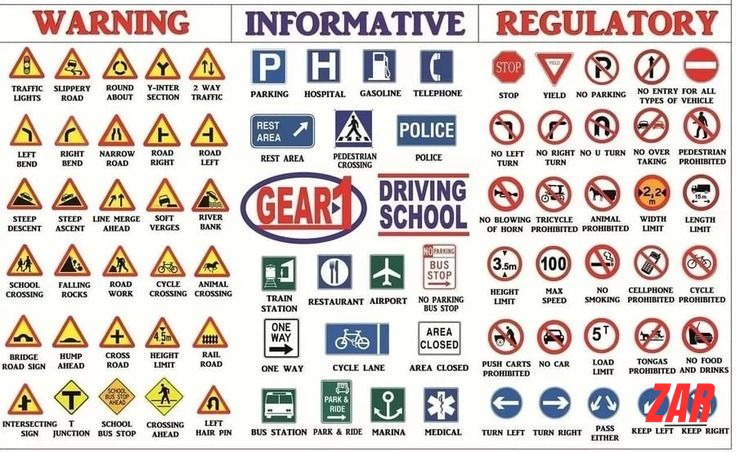
FRSC’s official road-sign guidance explains that road signs are identified by their shape and colour, which gives drivers a visual system for understanding what they are being told.
Once you understand this basic classification, learning individual road signs becomes much easier.
Regulatory Road Signs in Nigeria
Regulatory signs are the signs that control what road users can and cannot do. They communicate rules that apply to drivers and other road users.
FRSC divides regulatory signs into two main groups: prohibitory signs and mandatory signs. Prohibitory signs tell you what you must not do, while mandatory signs tell you what you must do.
Many regulatory signs are circular, although Stop is an important exception because it uses an octagonal shape.
Prohibitory Road Signs
Prohibitory signs generally tell drivers not to perform a particular action.
Examples include No Entry, No Left Turn, No Right Turn, No U-Turn, No Overtaking, No Parking, No Stopping and No Horn signs. Speed-limit signs are also regulatory because they establish the maximum permitted speed for a particular road section.
There are also regulatory restrictions for certain vehicle dimensions and weights. A sign may restrict vehicles based on height, weight or axle load, while other signs can prohibit particular vehicle types from entering a road.
The Stop sign deserves special attention. Although it is a regulatory sign, it does not use the usual circular shape. It is octagonal, making it instantly recognisable even from a distance.
The important thing about prohibitory signs is that they are not suggestions. If a sign says No Entry, you should not enter. If it says No Overtaking, you should remain behind the vehicle ahead until overtaking is permitted.
Mandatory Road Signs
Mandatory signs tell you what you must do.
They are generally circular with a blue background and white symbol. Examples include Keep Left, Keep Right, directions for turning, roundabout movement, minimum-speed requirements and instructions to pass on either side.
You may also see mandatory signs applying to specific road users or vehicle categories, such as buses or cycles, where the appropriate sign is displayed.
The easiest way to remember the difference between the two regulatory groups is simple: prohibitory signs tell you what not to do, while mandatory signs tell you what you must do.
A supplementary plate beneath a regulatory sign can provide additional conditions. For example, a restriction may apply only during certain hours or to particular vehicle types.
Warning Road Signs in Nigeria
Warning signs serve a completely different purpose. Instead of giving you a direct instruction such as “do not enter”, they tell you that something potentially dangerous or unusual is ahead.
Warning signs are generally triangular with a red border. They may warn drivers about road layouts, traffic conditions, pedestrians, animals or changes in the road surface.
Common warning signs include curves, double curves, crossroads, T-junctions, Y-junctions and side roads. Other examples include roundabouts ahead, narrow roads, narrow bridges, pedestrian crossings, school areas, slippery roads and roadworks.
There are also warnings for uneven roads, bumps, steep hills, railway crossings, cattle or wild animals and two-way traffic.
The purpose is to give you time to react before reaching the hazard. If you see a sharp-bend warning, for example, you should reduce your speed before reaching the bend rather than waiting until you are already inside it.
That is why warning signs are particularly important on Nigerian highways. A driver travelling at high speed has much less time to react when a hazard appears suddenly.
The Give Way Sign Is Different
Give Way can confuse new drivers because its shape resembles a warning sign. It is an inverted triangle, but its function is regulatory.
The sign tells you to yield to traffic that has priority. You should approach carefully and be prepared to stop when necessary.
This is a useful reminder that shape is a clue, not the entire meaning of a road sign. You still need to understand the symbol and the rule attached to it.
Informative Road Signs in Nigeria
Informative signs are designed to guide drivers and provide useful information.
They can tell you the name of a location, the distance to a destination, which lane to use or where to find a particular service. They are commonly rectangular and can appear in different colours depending on their purpose.
Examples include place-name signs, distance signs, advance direction signs and lane-direction information. Drivers may also encounter signs pointing towards hospitals, filling stations, parking areas, airports, motor parks, ferry terminals, first-aid facilities, mechanical services and lay-bys.
Imagine travelling from Lagos towards Ibadan and approaching a major interchange. You may know your destination, but you still need to know which lane or exit will take you there. An informative road sign provides that information before you reach the decision point.
This is why informative signs become especially useful during long-distance journeys. They help drivers navigate unfamiliar roads without constantly stopping to ask for directions.
The Federal Ministry of Works and Housing is also responsible for national highway infrastructure and publishes standards and technical materials relating to highways and road infrastructure.
How the Three Types Differ in Practice
The easiest way to understand the three types of road signs in Nigeria is to remember their main jobs.
Regulatory signs control. They tell you what you must do or must not do.
Warning signs alert. They tell you that a hazard, unusual condition or change in the road is ahead.
Informative signs guide. They provide directions, destinations, distances and information about services.
You can encounter all three within a very short distance.
For example, a warning sign could tell you that a roundabout is approaching. A regulatory sign could tell you which direction you must follow or what speed restriction applies. An informative sign could then identify the destination reached through a particular exit.
The three categories therefore work together to keep traffic organised and help drivers make decisions.
Can You Be Fined for Ignoring Road Signs?
Some road-sign-related violations can attract fines and penalty points, but there is no single fine that applies to every regulatory sign.
FRSC’s published offence information includes specific penalties for violations such as Caution Sign Violation, Construction Area Speed Limit Violation and Light/Sign Violation. For example, its offence sheet lists ₦3,000 and three points for Caution Sign Violation, ₦3,000 and three points for Construction Area Speed Limit Violation, and ₦2,000 and two points for Light/Sign Violation.
This means drivers should be careful about claims that every ignored regulatory sign automatically attracts a particular ₦2,000–₦5,000 fine. The actual consequence depends on the specific offence and applicable traffic regulation.
The more important point is that regulatory signs communicate enforceable rules. Ignoring them can result in enforcement action and, in some cases, create dangerous situations for other road users.
Which Type of Road Sign Matters Most?
It depends on where and how you are driving.
Regulatory signs are particularly important in busy urban areas because they control traffic movement, turning restrictions, parking, speed limits and access. Ignoring one can quickly create congestion or put you on the wrong side of the road.
Warning signs become especially important on highways and unfamiliar roads. A bend, narrow bridge, slippery surface, railway crossing or roadwork area can become dangerous when approached without enough preparation.
Informative signs are particularly useful during long trips. They help you find destinations, choose lanes and identify services such as fuel stations, hospitals and parking areas.
So there is no single category that drivers should learn while ignoring the others. Safe driving requires an understanding of all three.
Why Shape and Colour Matter
Imagine driving along a highway and seeing a road sign from a distance. You may not be able to read the words yet, but you can probably recognise whether it is circular, triangular or rectangular.
That visual recognition gives you an early warning about what kind of information is coming.
A circular regulatory sign should make you think about a rule or restriction. A triangular warning sign should make you look for a hazard. A rectangular informative sign is more likely to provide directions, destinations or services.
FRSC’s road-sign materials emphasise the importance of shape and colour in identifying signs.
The National Road Traffic Regulations also provide the legal framework governing road traffic signs and road-user requirements in Nigeria.
Learning these patterns can make your reactions quicker because you can begin interpreting the sign before you have fully processed the symbol.
Road Signs and Driver Training in Nigeria
Road signs are not something drivers should learn only because they might appear during a driving test. They are part of proper driver education.
The FRSC Driving School Standardization Programme includes Road Signs and Markings as part of driver training. The programme is designed to improve drivers’ knowledge of road traffic signs, regulations and safe driving practices.
This distinction is important because recognising a sign and responding correctly are two different things.
A driver may know that a slippery-road sign means the road ahead could be dangerous but still continue at excessive speed. Proper driving means recognising the warning and changing your behaviour accordingly.
Good road-sign knowledge therefore combines recognition, judgement and action.
Final Thoughts
The types of road signs in Nigeria become much easier to understand when you learn the system rather than trying to memorise hundreds of individual signs.
There are three main categories: regulatory, warning and informative signs. Regulatory signs control what road users must or must not do and include both prohibitory and mandatory signs. Warning signs alert drivers to hazards and unusual road conditions, while informative signs provide directions, destinations and useful services.
A simple way to remember them is: regulatory signs control, warning signs alert, and informative signs guide.
Once you understand these three functions, individual road signs become easier to recognise. You will also be better prepared to understand what a sign is asking you to do before you reach the junction, hazard or destination.
For individual examples, continue with our guides to road signs in Nigeria, road signs and their meanings in Nigeria, and 10 road signs in Nigeria and their meanings.