There is no shortage of opinions about Turo. Search the platform’s name alongside the word “reviews,” and you will find everything from enthusiastic five-star endorsements to detailed accounts of billing disputes, vehicle misrepresentation, and customer service experiences that left both renters and hosts frustrated enough to document them publicly. The range is wide, the sentiments are strong, and the volume of feedback is substantial enough to draw some genuinely useful conclusions about what the platform does well, where it consistently falls short, and who it actually works best for.
Turo occupies a position in the travel economy that did not exist fifteen years ago. As the largest peer-to-peer car sharing marketplace in the United States with operations extending into Canada, the United Kingdom, Australia, and France, it connects people who want to rent a vehicle with private individuals willing to list their personal or investment cars. The model cuts traditional rental agencies out of the equation, theoretically delivering better prices for renters and meaningful income for hosts. In practice, the experience on both sides of that transaction varies considerably, and understanding that variance is what Turo reviews, taken in aggregate, is actually useful for.
What Turo Is and How It Differs From Traditional Car Rental
Before examining what reviewers actually say, it helps to understand the structural differences between Turo and a conventional rental agency, because those differences explain most of the praise and most of the complaints.
When you rent from Hertz, Enterprise, or Avis, you are transacting with a corporation that owns its fleet, employs its staff, maintains its vehicles to a standardized schedule, and carries institutional insurance across every car on the lot. The experience is predictable, sometimes frustratingly so, but the baseline of what you will receive is relatively consistent. The car will be what the category description suggests. The pickup location will be staffed. If something goes wrong, there is a clear chain of institutional accountability.

Turo operates on entirely different logic. Each listing is managed by an individual host who sets their own pricing, writes their own vehicle description, determines their own delivery and pickup arrangements, and maintains the car according to their own standards. Turo provides the marketplace infrastructure, the payment processing, and an insurance framework, but it does not own the cars, employ the hosts, or guarantee consistency across listings. What you get depends heavily on who listed the car and how seriously they take the hosting role.
This is, depending on your perspective, either the platform’s greatest strength or its most significant liability. For renters who find an engaged, professional host with a well-maintained vehicle, Turo delivers an experience that traditional rental agencies genuinely cannot match: personalized service, unique vehicles, competitive pricing, and the kind of flexibility that institutional processes rarely allow. For renters who encounter a disengaged host, a car that does not match its photos, or a dispute that Turo’s support team handles poorly, the absence of institutional accountability becomes acutely apparent.
Turo Reviews From Renters: The Consistent Themes
Across review platforms, including the App Store, Google Play, Trustpilot, Reddit’s r/turo community, and Consumer Affairs, renter reviews of Turo cluster around a set of recurring themes that appear with enough consistency to be treated as structural rather than anecdotal.
The vehicle selection is genuinely one of a kind. This is perhaps the most universal point of praise in renter reviews. Turo’s inventory includes vehicles that no traditional rental agency stocks: classic cars from the 1960s and 1970s, hypercars and sports cars available by the day, vintage trucks, electric vehicles from brands that rental agencies rarely carry at scale, and an enormous variety of SUVs, vans, and wagons that give renters real choice rather than the binary between an economy hatchback and a midsize sedan. Reviewers who specifically sought out a vehicle type they could not find elsewhere, for example, a lifted 4×4 for an off-road trip or a Tesla for a road trip with charging infrastructure in mind, a vintage Porsche for a weekend drive consistently report high satisfaction because the platform delivered something their alternatives could not.
Pricing is competitive but not always as cheap as it appears. A significant thread in renter reviews concerns the gap between the advertised daily rate and the total cost after Turo’s fees are applied. The platform charges a trip fee that varies based on the host’s protection plan selection, and this can add 15 to 40 percent to the headline daily rate by the time checkout is reached. Reviewers who did not anticipate this, particularly those who compared the daily rate directly to a traditional rental agency’s advertised price frequently describe feeling misled, even though the fee structure is disclosed during the booking process. The practical advice that experienced Turo users share consistently is to always calculate the total trip cost rather than anchoring to the per-day figure.
Host quality is the single biggest variable in the experience. This point appears in reviews with remarkable frequency from both satisfied and dissatisfied renters. A responsive host who keeps their car clean, meets the renter on time, explains the vehicle’s quirks, and responds quickly to any issues during the trip is the foundation of a genuinely excellent rental experience. A host who communicates slowly, delivers a car that smells of smoke despite the listing stating otherwise, or disputes the security deposit return over pre-existing damage creates a rental experience that no platform infrastructure can rescue. Because Turo’s star rating system is visible on every listing, the advice most commonly given in community forums is to filter for hosts with significant reviews and high ratings before booking, particularly for longer or higher-stakes trips.
The pickup and return process is smoother than many expect. Turo offers two primary handoff mechanisms: in-person handoffs coordinated directly between host and renter, and contactless delivery where the host leaves the car at a designated location and the renter completes vehicle inspection through the app. Reviewers who have experienced both generally prefer in-person handoffs for the opportunity to ask questions, document the car’s condition jointly, and establish a human relationship with the host. Contactless delivery draws more mixed feedback praised for convenience when it works smoothly, and criticized when the car’s location is ambiguous, the app’s photo documentation process is unclear, or the renter later faces a damage dispute without a shared record of the car’s pre-trip condition.
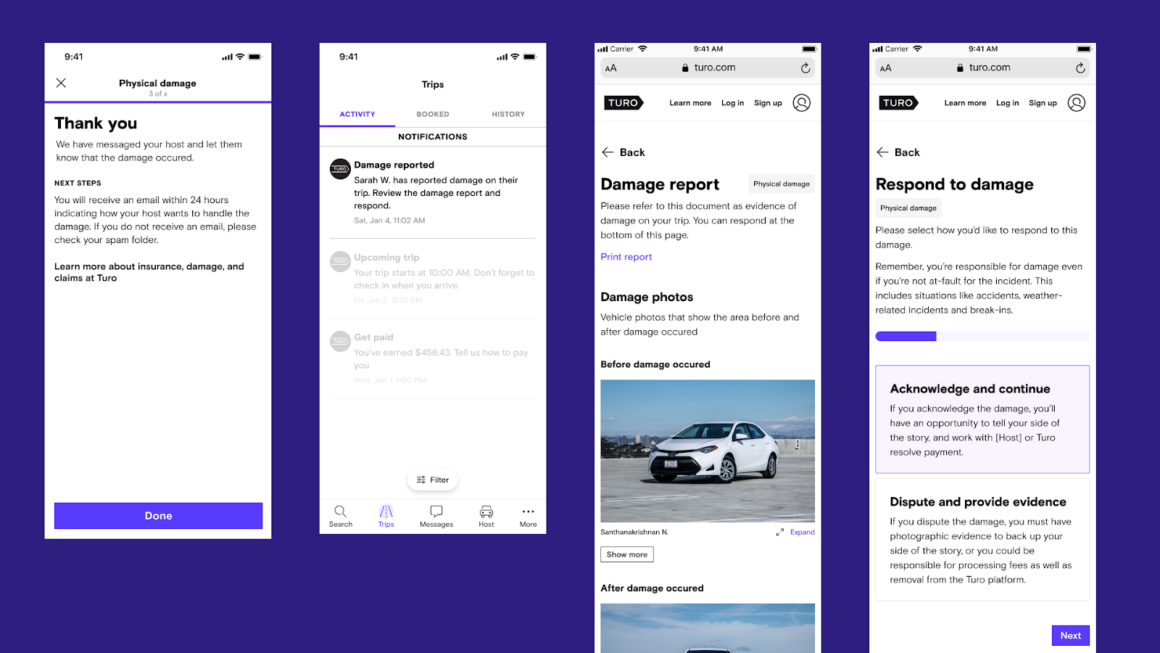
Damage disputes and security deposit handling are the most common source of negative reviews. This is the area where Turo’s review profile takes its most significant hits, and it is worth examining carefully. When a renter returns a vehicle and a host subsequently claims damage that the renter disputes, the resolution process involves Turo’s claims team as an intermediary. Reviewers on both sides of these disputes renters who believe they are being charged for pre-existing damage, and hosts who believe renters are denying responsibility for genuine damage frequently describe the resolution process as slow, frustrating, and lacking in transparency. The platform’s position as marketplace rather than insurer means that disputed claims can take weeks to resolve, and outcomes that leave one party dissatisfied generate the most detailed and emphatic negative reviews.
Turo Reviews From Hosts: A Different Set of Concerns
The host side of Turo’s review ecosystem tells a different story, shaped by different priorities and different points of friction. Hosts ranging from individuals who list a personal car to supplement their income, to professional operators managing fleets of dozens of vehicles evaluate Turo primarily on the income it generates, the quality of renters it delivers, and the platform’s behavior when something goes wrong with their vehicle.
The income potential is real but requires active management. Hosts with well-located, well-priced, and well-presented vehicles in high-demand markets, major cities, airport-adjacent areas, and tourist destinations consistently report meaningful income. A popular vehicle in a high-demand market can generate $1,500 to $3,000 or more per month at strong utilization rates, and Turo’s Carculator tool gives prospective hosts an estimate of earnings potential based on vehicle type, location, and pricing strategy. However, reviews from hosts who anticipated passive income without active management are considerably less positive. Vehicle availability management, pricing adjustments to match demand cycles, communication response times, and cleaning and maintenance between trips all require ongoing attention. Hosts who treat Turo as a passive income stream without building operational discipline around it tend to generate fewer bookings, lower ratings, and ultimately less income than those who approach it professionally.
Vehicle wear and renter behavior are sources of genuine stress. Host reviews frequently reference the tension between wanting bookings and being anxious about how renters will treat the car. Turo’s protection plans offer varying levels of coverage, with the highest tier providing comprehensive protection for the host’s vehicle, and the platform has made improvements to its claims process over successive years. But the fundamental reality that a stranger is driving your vehicle in ways you cannot observe creates ongoing anxiety for many hosts, particularly those listing newer or higher-value cars. Stories of vehicles returned with undisclosed minor damage, excessive mileage beyond trip expectations, interior odors from smoking or pets, or fuel levels below the agreed return state appear frequently in host community discussions.
Turo’s support for hosts during disputes is inconsistently rated. When renters dispute damage claims or when Turo’s claims team rules against a host’s damage report, the resulting reviews are pointed. The host community has a well-developed set of best practices for protecting against these outcomes, including comprehensive pre-trip photo documentation through the app, time-stamped images of all panels and interior surfaces, and explicit communication about mileage and fuel policies, but hosts who have not implemented these practices before a dispute arises frequently find the resolution process unsatisfying. Conversely, hosts who approach documentation methodically and maintain detailed records report more favorable outcomes from Turo’s claims process.
Superhost status changes the experience significantly. Turo’s Superhost tier, awarded to hosts who maintain high ratings, strong response rates, and consistent booking performance, comes with meaningful platform benefits: reduced fees, preferential search placement, and priority access to Turo’s support team. Reviews from Superhost-tier operators are measurably more positive than those from hosts operating below that tier, which suggests that the platform’s incentive structure rewards the behaviors responsiveness, vehicle quality, professional communication that also happen to produce better renter experiences. The gap between Superhost and standard host reviews is wide enough that it functions as a useful signal for renters choosing between listings.
How Turo’s Insurance and Protection Plans Actually Work
No review of Turo’s reviews is complete without addressing the insurance dimension, because it is the source of more misunderstanding and more consequential disputes than almost any other aspect of the platform.
Turo offers renters a choice of protection plans that determine their financial exposure in the event of an accident or damage claim. The most comprehensive plan covers physical damage and third-party liability up to Turo’s policy limits, at the highest cost. Lower-tier plans reduce the premium but increase the renter’s deductible or coverage exclusions. Renters who decline Turo’s protection plans entirely, typically because they believe their personal auto insurance or credit card coverage will apply, are sometimes surprised to discover that many personal auto policies explicitly exclude coverage for peer-to-peer rental vehicles, and that credit card rental coverage programs frequently carry similar exclusions.
This mismatch between what renters assume about their coverage and what their policies actually provide has generated a meaningful volume of negative reviews from renters who discovered the gap at precisely the wrong moment after an accident, when the financial consequences are immediate and the fine print becomes suddenly important. The practical recommendation from experienced Turo users and from insurance professionals who have examined the platform’s structure is consistent: verify your personal and credit card coverage explicitly before declining Turo’s protection, and do not assume that coverage that applies at Hertz will apply on Turo.
For hosts, Turo’s protection plans operate differently. The platform provides liability insurance for hosts during active trips through a policy administered by a third-party insurer, with coverage limits that vary by protection plan tier. Hosts whose personal auto insurance policies do not cover commercial use of their vehicle which describes most standard personal policies are dependent on Turo’s coverage framework for protection during rentals. Reviews from hosts who have had to navigate a significant claim through this framework range from reports of relatively smooth resolution to detailed accounts of extended delays, coverage disputes, and outcomes that fell well short of making the host whole.
The App Experience: Functional But Not Flawless
Turo’s mobile application is the primary interface through which both renters and hosts manage their experience, and it features prominently in reviews on both sides. The general assessment is of a functional platform that handles the core booking, communication, and documentation workflows adequately, with specific areas that generate recurring frustration.
The booking flow is generally praised as intuitive search, filter, view listings, review pricing with fees, book. The in-app messaging system that connects renters and hosts works reliably for most users. The trip photo documentation tool, which prompts both renters and hosts to photograph the vehicle at pickup and return, is an important feature that reviewers credit with providing meaningful protection in dispute situations when used thoroughly.
Areas that draw criticism include the customer support experience when issues escalate beyond what the app’s automated workflows can handle, the clarity of the fee breakdown at checkout, and occasional technical issues with contactless access features digital key systems and lockbox codes that some hosts and renters have integrated into their handoff processes. Reviews that reference support escalations are notably less positive than those describing experiences that stayed within normal parameters, which reflects the broader pattern that Turo works well when things go smoothly and encounters more difficulty when they do not.
How Turo Compares to the Alternatives
Understanding Turo reviews in isolation is useful, but understanding them in context is still useful. The relevant alternatives for renters include traditional rental agencies, Turo’s peer-to-peer competitors like Getaround and HyreCar, and subscription or fractional ownership services for longer-term vehicle access.
Against traditional rental agencies, Turo’s comparative advantages are vehicle variety, pricing flexibility, and the possibility of a more personalized experience. Its disadvantages are consistency, accountability, and the friction cost of navigating a peer-to-peer dynamic rather than an institutional one. For renters who know exactly what kind of vehicle they want and have the patience to evaluate individual listings carefully, Turo frequently wins the comparison. For renters who want guaranteed consistency with minimal cognitive load, traditional agencies remain a more predictable choice.
Against Getaround, the most direct peer-to-peer competitor, Turo’s larger fleet and greater geographic coverage give it a significant practical advantage in most markets. Getaround’s model emphasizes contactless, keyless access and shorter rental periods, making it more optimized for urban car-sharing use cases than Turo’s strength, which lies in daily and multi-day rentals.
What the Review Patterns Actually Tell You
Taken in aggregate, Turo reviews tell a coherent story that is neither the unqualified endorsement that the platform’s marketing implies nor the unmitigated disaster that the most emphatic negative reviews suggest. They tell the story of a marketplace that works well when both parties host and renter bring the right behaviors to the transaction, and that struggles when either side falls short of what the peer-to-peer model requires.
The platform rewards renters who research listings carefully, read host reviews thoroughly, document the vehicle’s condition comprehensively at pickup, understand their insurance coverage before booking, and calculate total trip cost rather than daily rate. It rewards hosts who present their vehicles accurately, communicate promptly, maintain their cars to a standard that matches their listings, and document every trip with the rigor that dispute avoidance requires.
For users who bring those behaviors to the platform, Turo’s reviews are predominantly positive and the value it delivers relative to conventional alternatives is genuine. For users who approach it casually, with the assumption that the platform’s infrastructure will compensate for insufficient diligence, the reviews tell a different story.
A Platform Worth Using, With Eyes Open
Turo is not for everyone, and its reviews make that clear without ambiguity. It is a platform that demands more from its users both renters and hosts than a traditional rental agency does, and it delivers more in return when those demands are met. The vehicle selection is unmatched in the rental space. The pricing, when total costs are calculated honestly, is often competitive. The experience of renting from an engaged, professional host with a well-maintained vehicle is genuinely better than what most airport rental counters can offer.
The challenges are equally real. Damage disputes generate some of the most frustrated reviews in the platform’s ecosystem. Customer support is inconsistent under pressure. The fee structure requires careful attention. Insurance assumptions need to be verified rather than presumed.
The most useful summary of what Turo’s aggregate review record communicates is this: the platform is a tool, and like most tools, it works best in the hands of people who understand how to use it properly. For renters who do the homework, it opens access to vehicles and experiences that conventional rental agencies cannot provide. For hosts who approach it with professional discipline, it generates income from assets that would otherwise sit idle. For both groups, the gap between a good Turo experience and a poor one is largely a function of preparation, which is perhaps the most honest thing that any review summary can say about a platform of this kind.