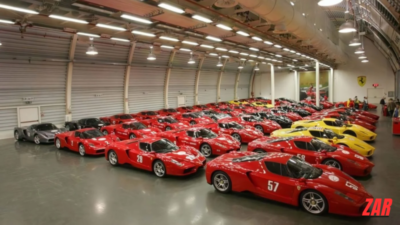
The Porsche 918 Spyder did not arrive quietly. When production began in September 2013, it entered a conversation alongside the Ferrari LaFerrari and McLaren P1, three hypercars announced within months of each other, each representing the absolute ceiling of what their respective manufacturers could engineer. Collectively, they became known as the Holy Trinity, and a decade later, that designation has only grown in significance.
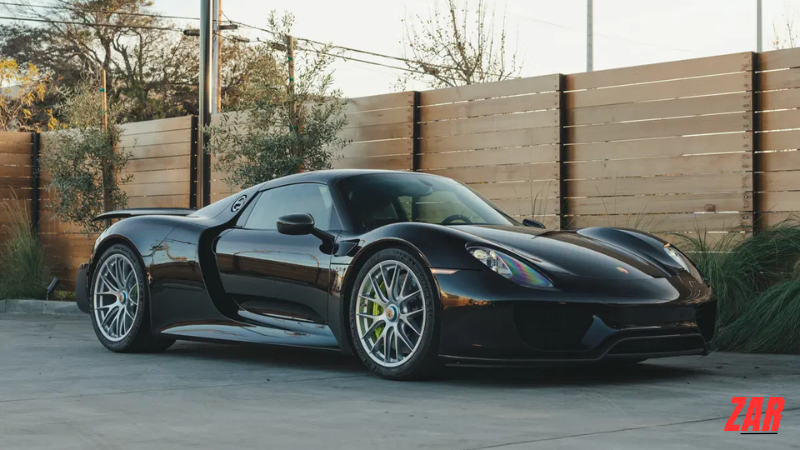
What made the 918 Spyder genuinely consequential was not its price; it was what Porsche chose to put beneath the bodywork, and how those choices redefined what a road-legal performance car could do. The 918 was not simply fast. It was fast in a way that required rethinking the hypercar’s entire architecture.
The Engineering Beneath the Body
At the core of the 918 Spyder sits a 4.6-liter naturally aspirated V8, derived directly from the RS Spyder Le Mans prototype racing program. On its own, that engine produces 608 horsepower and revs to 9,150 rpm, placing it firmly in motorsport territory in terms of character and delivery. But Porsche did not stop there.
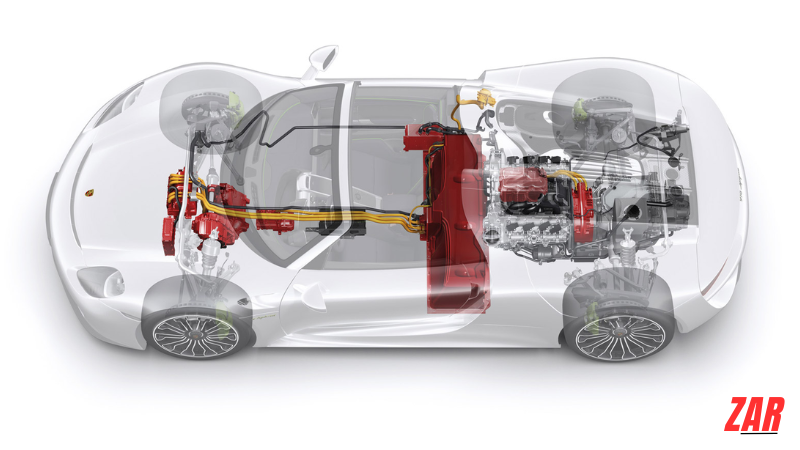
Two electric motors augment the combustion unit: one mounted on the rear axle alongside the V8, and a second positioned on the front axle. That front motor is not merely there for performance, it creates genuine all-wheel drive capability by independently driving the front wheels, a layout that gives the 918 a dynamic range few hypercars of its era can match. Combined system output sits at 887 horsepower and 944 lb-ft of torque, with the electric motors available to fill power gaps instantaneously in ways that no combustion engine alone can replicate.
The transmission is a seven-speed Porsche Doppelkupplung dual-clutch unit, and power is managed through a sophisticated control system that distributes torque between axles continuously and responds to driver input, road conditions, and selected driving mode simultaneously. Porsche developed five distinct operating modes for the 918 E-Power, Hybrid, Sport Hybrid, Race Hybrid, and Hot Lap, each calibrating the interaction between combustion and electric outputs differently. In E-Power mode, the 918 can cover short distances on electric power alone. In Hot Lap, every available joule is directed toward maximum performance with no reservation.
What the Numbers Actually Mean on Road and Track
Performance figures for the 918 Spyder were, at the time of launch, genuinely record-setting. The car accelerated from 0 to 60 mph in 2.5 seconds, reaching 124 mph in 7.2 seconds a figure that outpaced the McLaren P1 and matched the LaFerrari in most independent tests. Top speed was electronically limited to 214 mph.
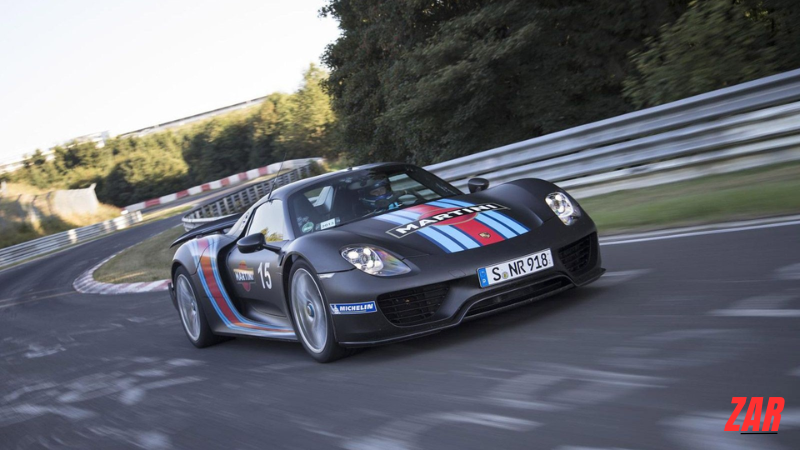
The more significant number, however, was the Nürburgring Nordschleife lap time. In 2013, a 918 Spyder equipped with the Weissach Package set a production car lap record of 6 minutes and 57 seconds around the 12.9-mile circuit, the first sub-7-minute lap by a production car in history. That record has since been surpassed, but the manner in which the 918 achieved it using hybrid torque fill through corners and deploying electric power on exits where wheelspin would otherwise rob time demonstrated that electrification was not a compromise in performance engineering, but rather an advantage.
The Weissach Package, which Porsche offered as a factory option, was built around a single principle: systematic weight reduction without sacrificing structural integrity. Carbon fiber reinforced polymer body panels replaced standard items, magnesium wheels replaced aluminum, the front anti-roll bar was deleted in favor of a lighter alternative, the roll bar structure was carbon fiber, and the exhaust system was titanium. The result was approximately 35 kilograms removed from a car that already weighed around 1,674 kilograms in standard form — not a dramatic percentage, but one that measurably altered high-speed behavior and transient response. On the secondary market, Weissach-equipped cars consistently trade at a premium that reflects this, with some examples exceeding $3 million in private transactions.
How The Porshce 918 Drives
Numbers alone do not explain why the 918 Spyder has aged so well in the collector consciousness. The car’s reputation among those who have driven it extensively is that it rewards engagement in ways that purely combustion-powered hypercars of the same era do not.
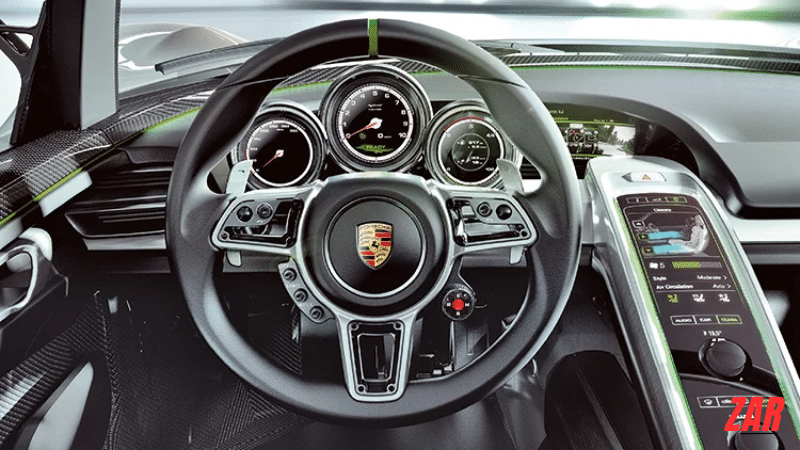
The naturally aspirated V8 provides the kind of linear, high-revving response that turbocharged rivals cannot replicate. There is no lag, no sudden surge, just a smooth, exponential build toward the 9,000-rpm ceiling that encourages the driver to hold gears longer than instinct suggests. Beneath that, the electric motors provide a foundation of torque that makes the car feel effortless at lower speeds, which paradoxically makes it more approachable than its performance figures imply.
The all-wheel drive system deserves particular credit here. Unlike some contemporary performance AWD systems, the 918’s front motor contributes actively to corner exits rather than simply preventing understeer. Drivers report a sense of the car pulling itself through corners from all four corners simultaneously, a sensation that is uncommon in road cars and gives the 918 a stability at speed that pure rear-wheel drive hypercars of comparable power cannot offer without significant driver commitment.
The chassis itself is built around a carbon fiber monocoque, with the engine and rear subframe mounted as stressed members, a structure that provides exceptional rigidity without the weight penalty of a conventional steel or aluminum platform. Pushrod suspension at both axles, borrowed directly from motorsport practice, allows precise tuning of the car’s handling balance in ways that conventional double-wishbone setups cannot match.
The 918 in the Context of Its Rivals
Placing the 918 Spyder alongside the Ferrari LaFerrari and McLaren P1 requires some precision, because the three cars made genuinely different engineering choices in pursuit of broadly similar goals.
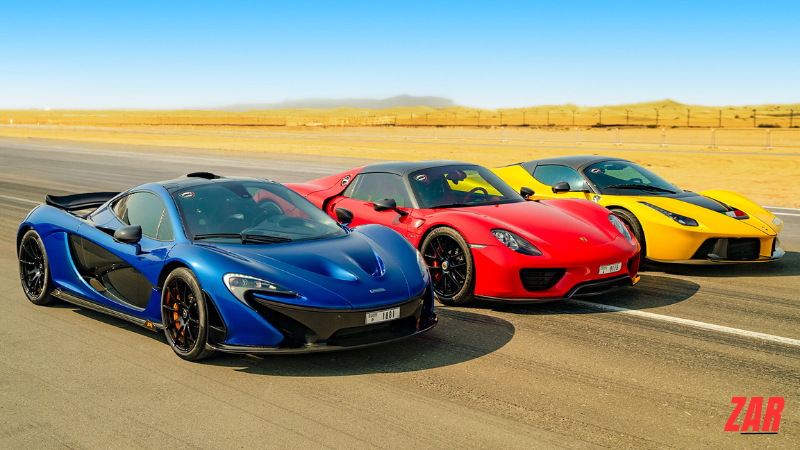
The LaFerrari used a 6.3-liter naturally aspirated V12 producing 789 horsepower, supplemented by a 161-horsepower electric motor for a combined output of 950 horsepower. Its HY-KERS system was derived from Ferrari’s Formula 1 KERS technology and stored energy from braking rather than from a plug-in source, meaning the LaFerrari could not be driven on electric power alone. The result was a car with extraordinary top-end character, particularly in the way the V12 builds from 7,000 rpm upward, but less everyday usability than the 918.
The McLaren P1 took a different route, pairing a twin-turbocharged 3.8-liter V8 with a 176-horsepower electric motor for a combined 903 horsepower. Where the Ferrari prioritized combustion purity and the Porsche prioritized hybrid integration and usability, the P1 was calibrated above all for dynamic precision. Its active aerodynamics, including a rear wing that could deploy up to 300mm and generate significant downforce, made it the most track-focused of the three on a closed circuit. In standard trim, its Nürburgring lap time was fractionally behind the 918 Spyder’s Weissach record.
Within this peer group, the 918 is generally considered the most technically ambitious in drivetrain architecture, the most usable in everyday conditions thanks to its plug-in capability and AWD layout, and the most direct expression of Porsche’s motorsport-to-road engineering philosophy. Its production run of exactly 918 units was chosen deliberately to match the model name, which sits above Ferrari’s 499 LaFerraris and McLaren’s 375 P1s. This partially explains why it trades at a slight discount to the LaFerrari on the secondary market despite comparable technical credentials.
What Drives Value, and What Ownership Costs
Clean 918 Spyder examples currently trade between $1.5 million (₦2B) and $2.5 million (₦3.3B) for standard specification cars, with Weissach Package examples and well-documented low-mileage cars regularly surpassing $3 million (₦4B). A handful of auction results the right color, original window sticker, and unbroken Porsche service history have pushed above $6 million (₦8B). Within that range, the variables that move individual cars higher are consistent: factory paint-to-sample specification, the full carbon fiber interior package, and Weissach exterior components represent the ceiling, while complete authorized-dealer service records command premiums over cars with documentation gaps, because buyers treat a verifiable maintenance history as a direct proxy for mechanical integrity on a drivetrain this specialized.
Battery health is the one technical consideration that sets the 918 apart from conventional hypercar purchases. Degradation in the lithium-ion pack affects not just electric range, but the car’s ability to deploy full system output under hard driving, and replacement is a high cost. Any serious pre-purchase inspection must include a battery assessment, and prospective buyers should factor potential pack work into their acquisition budget from the outset.
Beyond the purchase price, running a 918 Spyder means committing to specialist collector insurance typically $15,000 (₦20M) to $30,000 (₦40M) annually for agreed-value coverage along with annual maintenance through Porsche’s authorized network, which can reach five figures depending on what an inspection surfaces, and bespoke Michelin Pilot Sport Cup 2 tire replacements that carry both lead times and costs standard retailers cannot accommodate. These are the operating costs of one of the most sophisticated road cars ever built, and buyers who account for them honestly tend to find the ownership experience fully proportionate to the investment.
Why the 918 Spyder Remains Relevant
The conditions that produced the Holy Trinity, the regulatory environment, the state of combustion engine development, the specific hybrid technology available, and the willingness of manufacturers to absorb engineering costs at this scale without commercial return are unlikely to align again in quite the same way. The 918 Spyder is increasingly understood as a technological artifact as much as a performance car: a physical record of what Porsche could build at a specific moment in automotive history when combustion and electrification converged without either fully supplanting the other.
That understanding has informed both its cultural standing and its market trajectory. For buyers drawn to the 918 for what it actually is, an engineering achievement that rewards genuine engagement, the price premium attached to the best examples reflects something real and durable. The car’s performance credentials remain extraordinary by any contemporary standard, its driving character is widely regarded as among the most complete of its generation, and Porsche’s institutional support through its Classic program ensures that long-term ownership is viable rather than simply aspirational.