Car battery charger prices in Nigeria vary by charging current, supported battery type, build quality and seller. Listings reviewed in October 2026 included small 12V 6A chargers around ₦12,200 to ₦14,225, selected 10A chargers around ₦18,000 to ₦30,000 and a Suoer 12V/24V 20A model at ₦28,000. These are advertised examples, not a complete national price range.
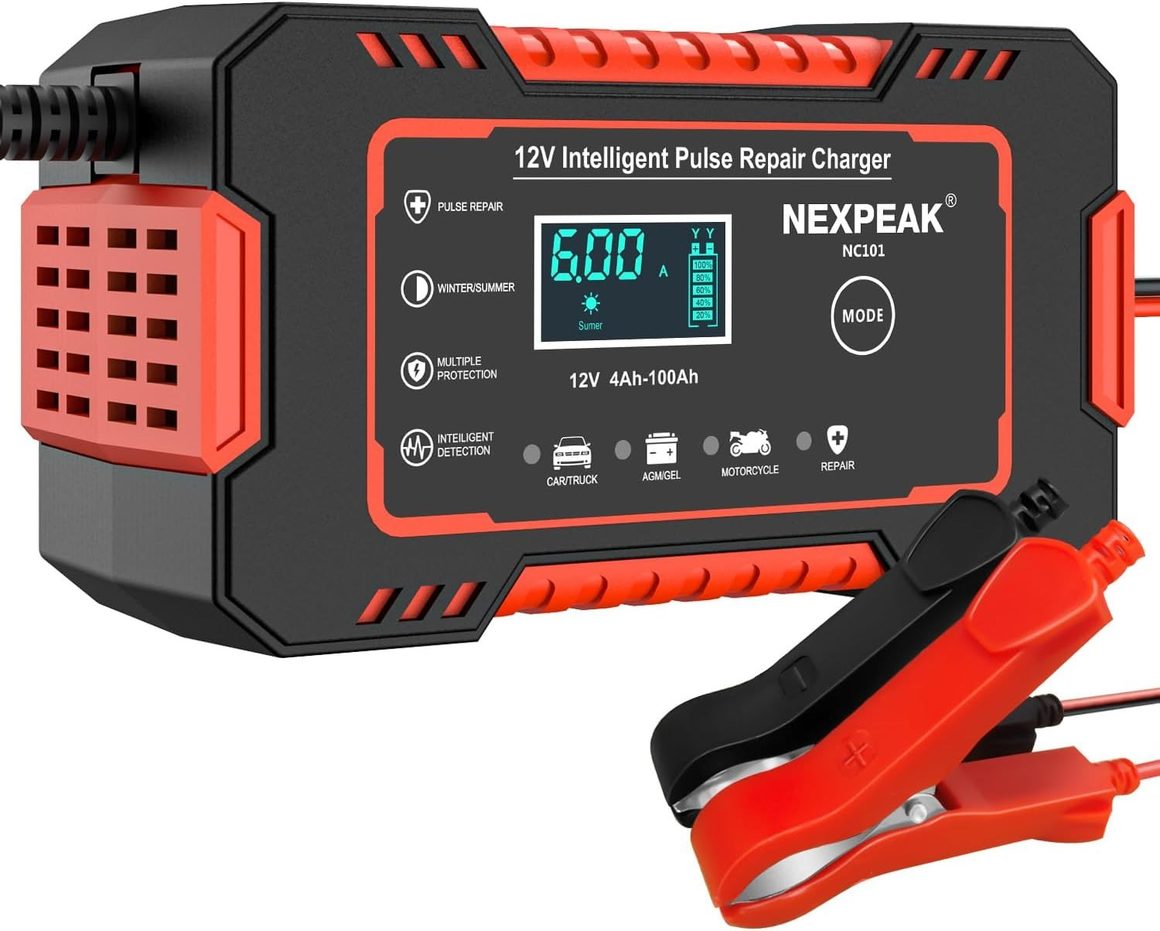
The right charger depends on the battery you need to charge and how you plan to use it. A device for maintaining a parked car has different priorities from equipment used regularly in a workshop. Before comparing prices, establish the battery voltage, chemistry and capacity, then check the charger’s documented compatibility and electrical input requirements.
How Much Is a Basic Car Battery Charger?
Jumia listings reviewed for this guide included a 12V 6A lead-acid charger at ₦12,200 and another automatic 6A charger at ₦14,225. These examples offer a more specific starting point than assigning every inexpensive charger to a broad brand category. Check availability and delivery charges before treating an advertised amount as your final budget.
Browse the Jumia 12V battery charger listings carefully because search results also include jump starters, batteries and unrelated power equipment. Confirm that the product actually charges an automotive battery from a suitable electricity supply. An attractive price means little if the listing describes a different kind of device from the one you need.
Basic does not necessarily mean unsuitable, but the product should have clear instructions and an identifiable specification. Ask about automatic charge control, supported battery types and the permitted capacity range. Avoid selecting a charger solely because the seller describes it as powerful, universal or suitable for every battery.
10A Car Battery Charger Prices in Nigeria
A Konga advertisement for the SON-1210D described a 12V charger with a maximum charging current of 10A at ₦18,000. Another listing advertised the same model designation at ₦18,500. These examples show why comparing identifiable models is more useful than grouping products together under informal labels such as “home charger.”
Other reviewed Jumia 10A advertisements included prices around ₦22,000, ₦25,900 and ₦30,000. The Konga 12V 10A charger listing provides one reference for requesting an updated quotation. Seller descriptions should still be checked against the unit’s label and manual, particularly when different advertisements use inconsistent terminology.
Some advertisements write “10Ah charger” when their specifications actually describe a 10A charging output. Amperes measure current, while ampere-hours describe battery capacity. This distinction matters when choosing equipment: a 10A charger is not restricted to a 10Ah battery, and the supported battery capacity must be checked separately.
20A and Workshop Charger Prices
A reviewed Konga listing priced a Suoer 12V/24V 20A smart charger at ₦28,000. Its description advertised selectable voltage, a digital display and applications including automotive batteries. Treat these as seller-stated specifications until confirmed through the actual model’s documentation, particularly if the charger will be used regularly for paid workshop jobs.
Check the available charging current at each voltage setting. A prominent “20A” label does not necessarily mean every mode delivers that current, and maximum output should not be confused with continuous performance. Request a clear model number, operating instructions and warranty terms before comparing it with another workshop charger.
For a garage, price should be weighed against practical requirements such as cable reach, supported battery sizes, cooling and service support. Ask whether the supplier can demonstrate the product on an appropriate battery. A higher advertised current is only useful when the battery permits it and the equipment can perform as documented.
Are the Suggested Charger Brands Reliable Price References?
Brand comparisons need actual model numbers. “Nairaland” identifies a discussion platform rather than a charger manufacturer, while “local market charger” says nothing definite about construction or performance. Likewise, a combined label such as “Hankook/professional” does not identify a product whose specifications, price or warranty can be checked.
Greenworks also require careful identification. Its official 40V charger page describes equipment compatible with Greenworks 40V battery packs. That product is not a charger for a conventional 12V car starter battery. Recognising a brand name should therefore be the beginning of your research, rather than proof that the advertised device suits your vehicle.
The supplied Everstart, Mighty Max, Arnold and Hankook price bands were not verified for specific charger models in this review. Ask sellers for the exact product identification and manufacturer documentation. Claims that one brand dominates Nigerian charger sales would also require evidence beyond individual advertisements or social media recommendations.
What Makes a Charger Smart?
A smart charger uses electronic control to manage charging according to its design and selected mode. However, the word “smart” does not guarantee identical features across products. Check the documented charge stages, maintenance function, battery compatibility and protective features instead of assuming that a digital display proves advanced charging control.
As a specification example, the NOCO GENIUS10 is a 10A charger supporting 6V and 12V batteries, with documented modes for several battery types. Its official GENIUS10 specifications are useful for understanding the detail a manufacturer should provide. They do not establish a Nigerian selling price, so request a separate local quotation.
For AGM batteries, choose a charger explicitly approved for that application and follow the battery manufacturer’s limits. An AGM setting is more informative than an unsupported claim that a charger is “fastest” or “safest.” Wheelzar’s guide to the best car battery in Nigeria provides background on battery categories you may encounter while shopping.
Check Mains Voltage Before Buying an Imported Charger
The charger’s input rating describes the electricity supply it accepts; the output rating describes what it delivers to the battery. These are separate specifications. A unit intended for a 12V battery can still require an incompatible mains supply, so inspect the input label before ordering imported equipment.
For example, the reviewed OPTIMA Digital 1200 manual specifies a 100–120V AC, 60Hz input. That version should not be plugged directly into a 230V supply. A simple plug adapter does not convert voltage or frequency. Confirm the exact regional model and its electrical requirements rather than assuming that every internationally sold charger is interchangeable.
By comparison, NOCO lists the GENIUS10 input as 120–240V AC at 50–60Hz. Always confirm the label on the actual unit being supplied. Also ask what happens after a power interruption: whether charging resumes, which mode returns and whether the manual requires you to check the settings before continuing.
Which Charger Works With a 75Ah or 100Ah Battery?
A suitable 10A charger can be appropriate for some 75Ah and 100Ah automotive batteries when both manufacturers’ instructions permit that combination. Capacity alone is insufficient to guarantee compatibility. Check voltage, chemistry, recommended charging current and the charger’s supported capacity range before connecting it to the battery.
A 20A model may reduce part of the charging time when the battery permits that rate, but faster is not automatically better. Smaller batteries may require a lower setting. If you plan to charge several different batteries, adjustable current and clearly documented modes may be more useful than buying the highest output available.
Do not select 24V because a battery is physically large or has a high Ah rating. A 12V 100Ah battery still requires the correct 12V charging mode. Vehicle systems containing multiple batteries require their own assessment, especially when the batteries remain connected together. Ask a qualified technician if you are unsure of the configuration.
How Long Does Charging Take?
Charging time depends on the amount of charge missing, the current the battery accepts and the charger’s programme. For illustration, a 100Ah battery at approximately half charge has roughly 50Ah to replenish. At a constant 10A, simple division gives five hours before allowing for losses and the slower finishing stage.
That calculation is a planning example, not a promise that the battery will finish charging in five hours. Current commonly reduces during later charging stages, and condition or temperature can affect progress. Follow the charger’s completion indication and instructions rather than disconnecting purely because an estimated number of hours has passed.
Charger, Maintainer or Jump Starter?
A battery charger replenishes charge over time, while a jump starter supplies a short burst of power to assist engine starting. A maintainer is intended to keep a compatible battery charged during storage, following its instructions. Some products combine functions, but buyers should confirm each capability rather than infer it from the packaging.
Choose according to the problem you want to solve. Emergency starting away from an electricity supply differs from maintaining a vehicle parked for weeks. If a listing prominently advertises very large peak amperage, check whether you are looking at a jump starter instead of a mains-powered battery charger.
Can Repair Mode Restore a Dead Battery?
Repair or desulfation modes should not be treated as guarantees that a failed battery will recover. NOCO describes its GENIUS10 repair mode as an advanced recovery function and warns that its higher charging voltage can affect sensitive electronics. Its guidance specifically requires battery disconnection to minimise electronic risks when using that mode.
Follow the instructions for both the charger and the vehicle before attempting any recovery procedure. A charger cannot make every worn or physically damaged battery serviceable. If testing shows replacement is necessary, Wheelzar’s car battery replacement cost guide can help you consider the alternative expense rather than repeatedly spending on unsuccessful charging attempts.
Safe Charging and Everyday Use
Read the charger and battery instructions before connection, including whether charging in the vehicle is permitted and which connection points to use. Work in a ventilated area away from flames and sparks, keep equipment dry and inspect cables for damage. Do not attempt to charge a leaking, swollen or otherwise visibly damaged battery.
Switch off and unplug the charger before attaching or removing connections, following the manufacturer’s sequence. Use the correct battery mode and keep cooling openings unobstructed. An automatic label is not permission to ignore operating instructions or leave any charger connected indefinitely; extended maintenance charging must be specifically supported by the equipment.
Nigeria’s hot conditions do not establish a universal need to recharge a car battery two or three times weekly. Frequent discharge deserves investigation into the battery, charging system, usage pattern or unwanted electrical drain. Include electrical checks in your routine servicing using Wheelzar’s car maintenance checklist to organise wider vehicle care.
Buying a Charger Without Wasting Money
Compare the complete delivered price and request written warranty terms before payment. Ask who handles faults, where the charger must be returned and whether local support is available. For an imported product, establish the final landed cost and confirm that the seller is supplying the compatible regional version.
Keep a copy of the advertisement and your receipt, including the model and agreed accessories. When the product arrives, compare the label with the order before use. A different-looking unit or missing manual should prompt clarification, especially if its voltage, battery modes or current rating differ from the seller’s description.
Choosing the Right Charger in 2026
The reviewed prices offer useful reference points, from smaller 6A chargers around ₦12,200 to selected 10A and 20A examples around ₦18,000 to ₦30,000. Other products cost more, and price alone does not establish quality. Prioritise a documented match for your battery and electricity supply, with clear instructions and support.
When comparing the car battery charger price in Nigeria, buy for your actual charging task. Confirm the battery type, permitted current, input voltage and total cost before deciding. A correctly specified charger, used according to its instructions, is a more useful purchase than an impressive brand claim or an unexplained maximum-amp figure.